1) The Pacific wasn’t supposed to have pirates
In the late 1500s, Spain’s enemies raided the Caribbean all the time—but the Pacific still felt like a private Spanish lake. One modern summary captures the shock bluntly: privateers were common in the “Spanish Main” but “were unheard of in the Pacific.” (Wikipedia)
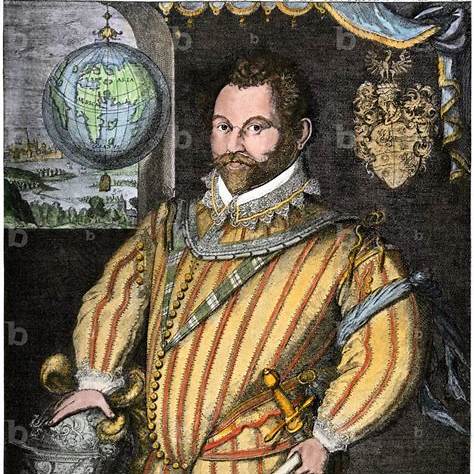
That assumption is the first reason Drake matters to Ecuador. When Golden Hind slipped through the Strait of Magellan into the Pacific, Drake didn’t just bring cannons—he brought a new idea: the Pacific coast is reachable, and the prize ships have schedules. (Wikipedia)
And once one outsider proves a route is possible, others follow.
2) Drake’s real weapon: intelligence
This is the part most pirate movies skip. Drake didn’t roam the Pacific randomly hoping to “find treasure.” He hunted one ship: the Spanish treasure galleon Nuestra Señora de la Concepción, better known by her infamous nickname “Cagafuego.” (Wikipedia)
How did he find her? Sources describe Drake raiding and probing along the coast—striking targets like El Callao (Peru) and gathering information about the treasure ship’s route and timing. (Wikipedia)
In other words: Ecuador becomes the stage not because Drake “loved Ecuador,” but because the Peru–Panama trade lane ran right past it, and the “big money” ship had to pass a predictable stretch of coastline. (Wikipedia)
3) The chase ends near Esmeraldas
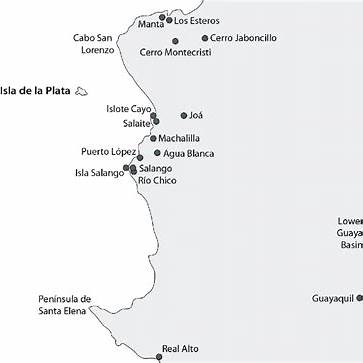
On 1 March 1579, the Golden Hind caught the Cacafuego “in the vicinity of Esmeraldas, Ecuador.” (Wikipedia)
The details read like a calm, patient ambush rather than a brawl. One account says Drake avoided slowing down openly (to avoid suspicion) and instead dragged objects behind his ship so he could wait for darkness; then he disguised his approach and closed in. (Wikipedia)
When the Spanish captain refused to surrender, Drake opened fire—his first broadside reportedly taking down the Cacafuego’s mizzenmast. (Wikipedia)
This moment matters for Ecuadorian coastal history because it fixes a coordinate in the pirate imagination: “near Esmeraldas” becomes a proof point—an English privateer can capture a Spanish treasure ship right off the Ecuadorian shoreline. (Wikipedia)
4) After the capture: the problem becomes logistics
Once you seize a treasure ship, your biggest enemy isn’t Spain—it’s physics.
You have:
- a crew that wants payment now,
- loot that is heavy, awkward, and hard to hide,
- and a coastline where fresh water can decide survival.
This is where Ecuador’s offshore islands step into the story—not as “mystical treasure islands,” but as places where you can stop, sort, repair, and—if you dare—divide the winnings.
5) Isla de la Plata: legend, geography, and the thirst problem
Off the Manabí coast, Isla de la Plata sits like a hinge between myth and navigation. The island’s Drake connection survives because later seamen kept repeating it.
The buccaneer-writer William Dampier recorded the famous tradition in his 1697 voyage account:
“The island Plata, as some report, was so named… after Sir Francis Drake took the Cacafuego…” (gutenberg.net.au)
He continues (still as reported tradition) that Drake “brought [the prize] hither and divided here with his men.” (gutenberg.net.au)
That quote does two things for a narrative explainer:
- It gives you an authentic historical voice without claiming certainty (“as some report”), and
- It shows how pirate history often lives in reported explanations as much as in official documents.
Then Dampier adds the detail that makes the story feel real—the island’s harsh practicality:
“There is no water on this island… it drills slowly down from the rocks…” (gutenberg.net.au)
That one line is pure coastal Ecuador: dramatic cliffs, dry ground, and water that must be waited for. It also explains why pirates and privateers used islands like staging posts. Even a small trickle can keep a crew alive long enough to repair a sail, rest, and plan the next move. (gutenberg.net.au)
So whether Drake truly divided treasure there or not, the island fits the logic of the story—and that’s why the legend sticks.
6) “El Draque”: why Spain remembered Drake so vividly
Spanish coastal communities didn’t need perfect paperwork to form a memory. They needed fear, rumor, and repeated warnings—because a single successful raid changed local behavior for decades.
One modern summary notes that Drake became known to his Spanish victims as “el Draque.” (Wikipedia)
That nickname is more than a label—it’s a sign that Drake entered popular memory as a kind of coastal ghost story: a foreign raider who appears where you thought you were safe.
And once a coastal region has a Drake, it starts preparing for the next one.
7) Drake’s shadow: how one raid seeds a century of copycats
Here’s the through-line that makes Drake the perfect “Part 2” focus:
- Drake’s success proved the Pacific raid was possible. (Wikipedia)
- Later raiders studied earlier voyages and reused the same anchor points and ideas—islands for staging, coasts for water, ports and ship lanes for value. (repository.lsu.edu)
Even later summaries of piracy history explicitly treat Isla de la Plata as the “little island” where Drake divided spoils, and argue that stories of his riches helped draw buccaneers into the Pacific “nearly a century later.” (Charles Darwin Foundation)
This doesn’t mean Drake caused every later attack. It means his raid became a template—a story other crews used to justify risk: “It worked for Drake. It can work for us.”
8) Myth vs fact (Drake edition)
Myth: “Drake is proven to have divided the Cacafuego treasure on Isla de la Plata.”
What we can say confidently: Dampier records it as tradition—“as some report”—which is valuable, but not courtroom certainty. (gutenberg.net.au)
Myth: “Pirate history is just battles.”
Fact: The most decisive constraints are often boring: speed, deception, fresh water, and where you can safely anchor. Dampier’s water note is the kind of detail that makes the era believable. (gutenberg.net.au)
Myth: “Ecuador’s coast is a side character.”
Fact: The capture’s recorded location “near Esmeraldas” puts Ecuador directly inside the most famous English prize of the voyage. (Wikipedia)
Mini epilogue in Spanish
Drake importa para la costa ecuatoriana por una razón simple: dejó una “prueba” de que el Pacífico era vulnerable. La captura del galeón Nuestra Señora de la Concepción (Cacafuego) el 1 de marzo de 1579 “cerca de Esmeraldas” conecta a Ecuador con el momento más famoso del viaje. (Wikipedia)
La leyenda de Isla de la Plata funciona como puente entre mito y geografía: Dampier la registra como tradición (“as some report”) y, al mismo tiempo, describe un factor real que condicionaba todo: la falta de agua dulce. (gutenberg.net.au)
Después de Drake, el mensaje quedó instalado: si se puede capturar un tesoro español frente a Ecuador una vez, otros lo intentarán otra vez.