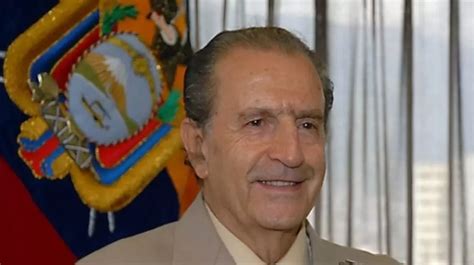
When Ecuadorians talk about Rodrigo Borja Cevallos, you’ll often hear two things in the same breath: “a democratic, institutional politician” and “a president who governed in a really hard economic moment.” Both can be true—because the late 1980s and early 1990s were a tough stretch for Ecuador, even by Ecuador standards.
Borja served as President of Ecuador from August 10, 1988 to August 10, 1992, as leader of the Izquierda Democrática (ID), a social-democratic party. (CIDOB)
He died in Quito in December 2025, and the government declared national mourning (Dec 19–21, 2025) by Executive Decree No. 260. (Minka)
1) Quick background: from law professor to party builder
Borja trained as a lawyer/jurist and political scientist, taught at the Universidad Central del Ecuador, and entered politics young. He was elected to Congress in the early 1960s, then returned to academic life after the 1963 military coup disrupted civilian politics. (Wikipedia)
In 1968, he helped found Izquierda Democrática, aiming for a non-Marxist, democratic left option in Ecuador’s political spectrum. (Wikipedia)
2) The Ecuador Borja inherited: democracy was back, but the economy was bruised
Ecuador returned to democracy in 1979, but the 1980s brought a sharp economic hangover—linked to debt, inflation, fiscal stress, and external shocks. (U.S. Department of State)
An academic overview of Ecuador’s macro history notes that when Borja took office in August 1988, he faced a very weak starting position—including fiscal imbalance, problems with reserves, and disorderly money growth coming out of the late-1980s crisis. (Becker Friedman Institute)
So, a useful way to picture his presidency is: governing a fragile democracy while trying to stabilize a fragile economy—with the added complication that Ecuador was in the middle of the region-wide “adjustment and reform” era tied to global finance and IMF-style policy debates. (SciELO)
3) What his government tried to do (and why people still argue about it)
A) A “plan” style of government (and the official development strategy)
Borja’s administration produced a formal national development blueprint, the Plan Nacional de Desarrollo Económico y Social 1989–1992, preserved in the Banco Central del Ecuador repository. (Banco Central del Ecuador)
If you want a primary source for “what his government said it was trying to do,” this is one of the best places to start. (Banco Central del Ecuador)
B) Stabilization under pressure (inflation, debt, and tough tradeoffs)
His government pursued anti-inflation and fiscal measures in a context where Ecuador was coming off very high inflation and macro instability. (Becker Friedman Institute)
That kind of stabilization usually produces debate—because it can mean real short-term pain (jobs, wages, purchasing power) even when it aims at long-term control.
C) Indigenous politics moved to the center of national life (1990 uprising)
A major political and social turning point during Borja’s term was the 1990 Indigenous uprising, associated with CONAIE and broad demands around land, rights, and recognition. (NACLA)
Even if you don’t focus on the day-by-day events, the big takeaway is that Ecuador entered a new era where Indigenous movements became unavoidable national political actors—shaping debates that continue today. (UNM Digital Repository)
D) Foreign policy: trying to lower the temperature with Peru
During Borja’s presidency, Ecuador experienced renewed tension with Peru in 1991 (the long border dispute era before the final 1998 settlement). A diplomatic-history paper linked to Ecuador’s foreign service describes Borja going to the United Nations and proposing a peaceful route (including the idea of papal arbitration) as a way out of the long impasse. (afese.com)
This is part of why he is often remembered as a leader who emphasized diplomacy and institutions in foreign policy.
4) How to think about “accomplishments”
With Borja, it helps to separate goals, constraints, and results:
- Goals: democratic governance, institutional strength, planned development, stabilization. (CIDOB)
- Constraints: a battered late-1980s economy, high inflation pressures, debt/financing limits, and big social demands coming to the surface. (Becker Friedman Institute)
- Results: mixed—some people emphasize institutional tone and diplomacy; others remember the economic difficulty and the unavoidable austerity-style debates of that era. (SciELO)
That’s not a cop-out—it’s a fair reflection of how governing looked in Ecuador at that time.
5) Where to learn more (reputable starting points)
If you want good “read more” links for your explainer page:
- CIDOB political biography (solid structured overview, dates, party, career). (CIDOB)
- BCE repository: Plan Nacional de Desarrollo 1989–1992 (primary-source government planning document). (Banco Central del Ecuador)
- Macro context paper (U. Chicago BFI): The Case of Ecuador (helps explain the scale of the 1988 starting crisis). (Becker Friedman Institute)
- Indigenous uprising context (NACLA / Acción Ecológica) (why 1990 mattered). (NACLA)
- Foreign-policy / Peru dispute context (AFESE + scholarly analysis) (1991 diplomacy and the border issue’s political weight). (afese.com)
- Official mourning decree portal (Decreto 260) for the 2025 national mourning notice. (Minka)
English / Spanish summary
EN summary: Rodrigo Borja (President 1988–1992) led Ecuador as a social-democratic figure during a difficult period marked by late-1980s economic instability and major social mobilization. His government pursued stabilization and a formal development plan, while Ecuador saw Indigenous politics surge to the center of national debate in 1990 and foreign policy grappled with renewed Peru tensions in 1991. (CIDOB)
ES resumen: Rodrigo Borja (presidente 1988–1992) gobernó como figura socialdemócrata en una etapa compleja, con inestabilidad económica heredada de fines de los 80 y una fuerte movilización social. Su gobierno impulsó medidas de estabilización y un plan formal de desarrollo; en 1990 el movimiento indígena ganó un papel central en la política nacional y en 1991 la política exterior enfrentó tensiones renovadas con el Perú. (CIDOB)