Introduction
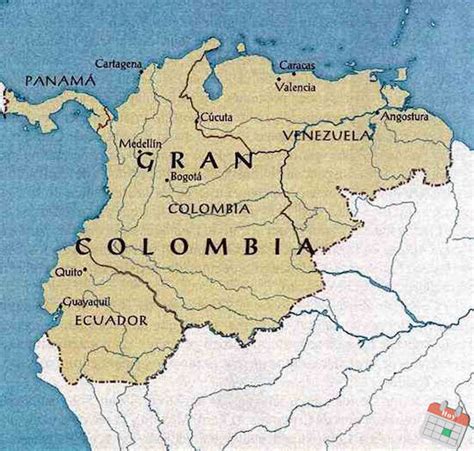
After Pichincha (1822), the big question wasn’t only “Spain is leaving.” It was: What replaces the empire? For the Quito highlands, the answer became Gran Colombia—a giant, fast-built republic meant to keep the independence project alive, pay for armies, and prevent the region from fragmenting into weak mini-states. But the same size that gave Gran Colombia power also made it hard to govern—especially from Bogotá across mountains, rival ports, and strong local identities. (Encyclopedia Britannica)
1) Why join Gran Colombia (1822)
Think of it as a practical decision in a dangerous moment:
A) Security and finishing the war
Even after a decisive battle, the region was still fragile. Joining a larger republic meant being under a stronger military umbrella and diplomacy network. (Encyclopedia Britannica)
B) Legitimacy and “a real state now”
Gran Colombia had a founding constitutional framework (the Constitution of Cúcuta, 1821) with a president/vice president and a national congress structure—basically, a ready-made state machine. (Wikipedia)
C) The Guayaquil factor
Guayaquil’s future was contested. Once Gran Colombia’s military weight was dominant in the Sierra and Bolívar’s politics arrived at full volume, the “three doors” narrowed fast and Guayaquil was incorporated in 1822, pulling the whole territory into one framework. (Wikipedia)
2) How Gran Colombia functioned (and what “Ecuador” was inside it)
The structure
Gran Colombia was organized into large administrative units; the southern zone was commonly described as the Southern District/Department of Quito (often called the Department of Ecuador in later descriptions). (Wikipedia)
What governance felt like on the ground
- Quito: more central-administration logic—officials, courts, paperwork, and the feeling that the political “center of gravity” is inland.
- Guayaquil: port logic—customs revenue, trade, and the worry that decisions are being made far away by people who don’t live the port’s reality.
- Cuenca/Loja: regionalism stays strong; the South has its own identity and networks, and doesn’t automatically accept being managed from either Quito or Bogotá.
The key point: Gran Colombia could write laws, but distance made implementation uneven—so local power didn’t disappear; it adapted.
3) Why separation happened (1830)
Gran Colombia didn’t fall because one person woke up and quit. It unraveled because several stresses stacked up:
A) Regionalism + distance
A republic that stretches from modern Panama through Colombia, Venezuela, and into the Quito region has a built-in problem: regions feel they’re paying costs without getting equal voice. Dissolution histories emphasize the breakdown of central authority and regional disputes. (Wikipedia)
B) Political crisis at the center
The 1820s were full of constitutional and leadership conflict (Bolívar vs other factions, debates about centralism/federalism). By 1830, the project was politically exhausted, and the machinery stopped holding. (Wikipedia)
C) Local elites choosing “manageable sovereignty”
For many leaders in the southern district, the question became:
Is it easier to bargain inside a huge, unstable republic—or to build a smaller one where Quito/Guayaquil/Cuenca can negotiate directly?
That logic leads to the key step: the southern district declares separation and forms the Republic of Ecuador in May 1830 (commonly cited as 13 May 1830). (Wikipedia)
4) What stayed regional (even after “Ecuador” existed)
Separation didn’t erase the internal map. It concentrated it.
The three anchors that keep showing up:
- Quito = administrative-political center (state/legal culture)
- Guayaquil = economic-commercial center (port/customs/trade identity)
- Cuenca = strong regional civic identity and south-Andean networks
So “Ecuador becomes Ecuador” not as a perfect unity, but as a negotiated balance among powerful regions—each convinced it’s essential.
5) Everyday consequences (what ordinary people actually noticed)
- Officials and clerks: whose stamp counts now? whose appointments survive?
- Merchants: customs rules, tariffs, which currency/credit networks are trusted
- Soldiers and families: who commands the army, who recruits, who pays
- Towns along routes: fewer “foreign” administrators maybe, but still taxes and requisitions—just under a different flag
In other words: the big state story shows up as paperwork, prices, uniforms, and who gets to enforce rules.
Myths vs Reality (quick box)
Myth: Joining Gran Colombia was “just ideology.”
Reality: It was also security + governance capacity right after war. (Wikipedia)
Myth: Ecuador’s separation was “sudden.”
Reality: It followed years of regional tension and a collapsing center. (Wikipedia)
Myth: 1830 solved regional rivalry.
Reality: It moved the bargaining inside a smaller country—Quito/Guayaquil/Cuenca remain core poles.
English summary (6 sentences)
After 1822, joining Gran Colombia offered security and a ready state framework under the Constitution of Cúcuta (1821). The southern region (often described as the Quito/Ecuador department) operated inside a large republic where distance made central control uneven and local identities remained strong. As political conflict and regional disputes weakened the center, the “big republic” became harder to manage than a smaller one. In May 1830, the southern district separated and formed the Republic of Ecuador. “Ecuador becomes Ecuador” through this shift from continental unification to workable sovereignty. The same regional poles—Quito, Guayaquil, and the southern Sierra—continued shaping politics afterward. (Wikipedia)
Resumen en español (6 oraciones)
Después de 1822, unirse a Gran Colombia ofrecía seguridad y un marco estatal ya armado con la Constitución de Cúcuta (1821). La región del sur (frecuentemente descrita como el departamento/distrito de Quito o Ecuador) funcionó dentro de una república enorme, donde la distancia hacía desigual el control del centro y las identidades locales seguían fuertes. Con el tiempo, los conflictos políticos y las tensiones regionales debilitaron al gobierno central. Entonces, la opción “gran república” se volvió menos manejable que construir un Estado propio. En mayo de 1830, el sur se separó y nació la República del Ecuador. Ecuador se forma así: de un proyecto continental a una soberanía más práctica, sin borrar las regiones. (Wikipedia)
Learn more & verify (good starting links)
- Constitution of Cúcuta (1821) primary text (PDF). (constitutionnet.org)
- Britannica: Ecuador colonial/independence context incl. Pichincha. (Encyclopedia Britannica)
- Dissolution overview (regional disputes, breakdown of central government). (Wikipedia)
- Spanish Wikipedia pages are handy for dates/terms, but verify with primary/academic sources. (Wikipedia)